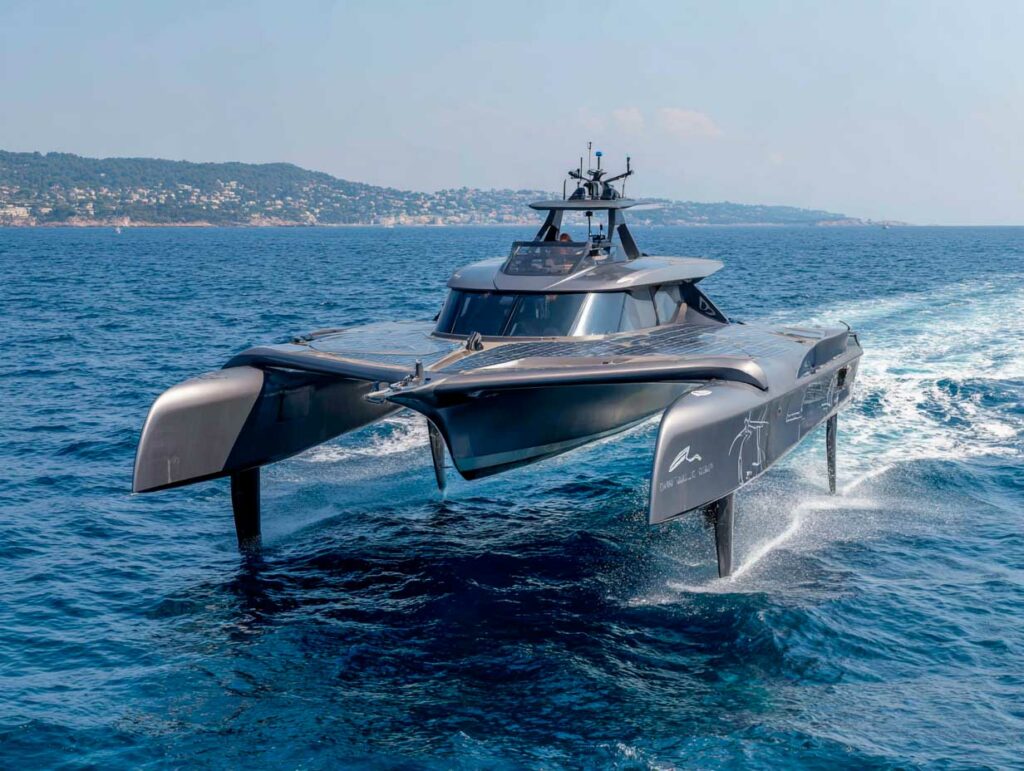
Foils on cruise ships: energy savings, stability, CO₂. But under what technical, economic, and size conditions does this become credible?
Foils promise to do for cruising what aerodynamics did for commercial aviation: reduce drag, stabilize, and lower energy costs. The principle is simple. Above a certain speed, underwater wings generate lift and relieve the hull. Less wet surface area means less drag, which means less power is needed. On fast passenger ships, studies and initial operational feedback suggest significant energy savings, sometimes in the order of 30 to 50% at a given speed. For cruising, the issue is more subtle: a giant ocean liner sails slowly and heavily, and “full foiling” is not realistic in the short term. On the other hand, hybrid solutions (assist foils, lifting appendages, intelligent stabilizers) are becoming credible because CO₂ regulations are tightening, because comfort at sea is a selling point, and because materials and active steering are advancing rapidly.
Foils and the promise of reduced drag
A foil is an underwater wing. When the ship moves forward, the flow around this wing creates lift. This lift can raise all or part of the hull. This is where the key factor comes into play: the hydrodynamic resistance of a boat comes largely from its wet surface area and the formation of waves. Raising the hull reduces friction and can also reduce wave drag.
Let’s be frank: on paper, this is one of the few levers capable of delivering a leap in efficiency, not just marginal gains. Recent publications on fast ferries indicate a potential energy reduction of 30% to 50% for foiling vessels compared to fast alternatives of comparable size and speed. This is huge on a regular operating scale, where fuel (or energy) is king.
But lift does not come “free.” Foils add their own drag. They require more robust structures. They demand fine control of trim and height to avoid shocks and maintain a steady ride. This is the key point: the performance of foils is not just a question of shape, but also of active steering, sensors, actuators, redundancy, and maintenance.
Key takeaway: the reduction in hydrodynamic drag is the number one argument, and it is the one that translates most directly into fuel consumption, and then into CO₂.
Critical size and the physical reality that catches up with marketing
The controversial question is this: “At what size does a ship become too big for foils?” There is no magic number, because it all depends on the target speed, the available draft, sea conditions, the mass of the ship, and the level of assistance sought (lifting 10% of the mass or 80% is not the same thing).
A modern cruise ship is often over 300 m long. Its displacement is in the tens, even hundreds, of thousands of tons. At typical cruising speeds (often around 18–22 knots, or about 33–41 km/h), the idea of “flying” such a monster on main foils faces three obstacles:
The wall of structural loads
The lift required is enormous. However, this lift is provided by anchor points in the hull. The more we want to relieve the hull, the greater the forces and the more complicated the structure becomes. On giant ships, this means additional weight, so some of the gains are lost.
The real sea wall
An ocean liner sails in varied seas. Foils like stability. Sea conditions impose load variations and the risk of slamming (impact) on appendages. Some modern hydrofoils claim to be able to operate in waves up to 2 m high, which is already an interesting threshold for passenger transport, but this does not cover all the conditions encountered on ocean routes.
The wall of cavitation and ventilation
As speed and load increase, we approach regimes where cavitation degrades efficiency, generates noise and erosion, and can limit usable speed. On a fast ferry, this is taken into account in the design. On an ocean liner, we want robustness and durability, not “consumable” foils.
Honest conclusion: the near future does not belong to giant cruise ships with full foils. The credible future is hybridization: assist foils, lifting appendages, advanced stabilization systems, and a naval architecture that exploits the idea of foils without pretending to transform a cruise ship into an AC75.
Stability and comfort, which ultimately weigh as much as fuel
An ocean liner sells an experience. And the experience is first and foremost the feeling on board. Foils and associated systems have an immediate value: improving seaworthiness.
In practice, two phenomena matter to passengers: rolling (lateral rotation) and pitching (forward/backward movement). Traditional solutions have been around for a long time: stabilizing fins, ballast, anti-roll devices, and routing software. What changes with the “foil” approach is the ability to generate vertical force and more effective and faster correction torques thanks to controlled lifting surfaces.
To put it bluntly, reducing roll and pitch has a direct impact on customer satisfaction, on the use of certain spaces, on crew fatigue, and on indirect consumption (when a ship slows down or changes course to maintain comfort, it loses time and therefore efficiency).
Feedback on electric foil vessels designed for passenger transport often emphasizes smooth sailing and reduced vibrations. This makes sense: when the hull is partially out of the water, hydrodynamic noise decreases, wave generation decreases, and the propulsion system can run at more favorable speeds.
Key takeaway: the stability of cruise ships at sea and passenger comfort are not just bonuses. In the cruise industry, they are sometimes selling points.
Fuel reduction and CO₂ constraints driving change
Cruise ships are facing a decade of constraints. Regulations are tightening. Alternative fuels are expensive. Customers and ports are looking at emissions. And shipowners have a simple problem: energy is a cost item, but it is also a regulatory risk.
The global movement is clear: the IMO’s climate strategy aims for net zero “by 2050” and ambitious interim milestones, with a reduction in emissions expected internationally by 2030 and 2040, as well as a ramp-up of very low-emission fuels and technologies. Even if the concrete application varies from region to region, the direction remains the same.
This is where foils become interesting for cruising, even in a “partial” version. Because reducing the power required means reducing fuel consumption, and therefore reducing costs, carbon footprint, and dependence on an uncertain future fuel supply.
On fast hydrofoil vessels, some public figures cite very significant reductions in energy consumption per passenger-kilometer. In the case of an electric hydrofoil ferry operating in real conditions, published data indicate consumption of around 0.39 kWh per passenger-kilometer, compared to 3.31 kWh for comparable units on the same route, and a massive difference in associated emissions when the energy is not decarbonized. This is not “cruising,” but it is proof that when you combine lift, active steering, and modern propulsion, you change the order of magnitude.
Applied to cruising, the reasoning is more cautious: an ocean liner cannot be reduced to one kWh per passenger-km, because it includes hotel, catering, HVAC, water, treatment, etc. But if we can save even a few percent on propulsion on an annual average, the financial impact is huge.
Key takeaway: reducing ship fuel consumption is the bridge between “innovation” and “investment decision.”
Technology that finally makes foils viable on a large scale
Foils have been around for a long time. What has changed is the industrial package: materials, sensors, on-board computing, active control, and predictive maintenance.
Materials and structures that go the distance
Modern foils use composites, optimized steels and alloys, and structural architectures that better manage fatigue. On fast vessels, the weight saved counts. On larger ships, robustness counts even more. The “cruise” logic will favor less extreme solutions, designed to withstand wear and tear, even if it means losing a little pure performance.
Active steering, the real breakthrough
Without active steering, a foil is unpredictable in rough seas. With active steering, it becomes “docile.” It’s the same leap forward as between an unstable aircraft without a computer and a modern aircraft. Flight altitude, angle of attack, wave compensation: everything is controlled in a closed loop. This is also why recent designs focus as much on software as on hull design.
Noise, vibrations, and the quest for a quieter vessel
When the hull rubs less, hydrodynamic noise decreases. If propulsion is electrified during certain phases, the noise signature decreases even further. For cruising, quieter boat navigation is not a gimmick: it affects comfort and acceptability in certain ports and sensitive areas.
Realistic architectures for cruising, far from the fantasy of the “flying ship”
To be credible, we need to distinguish between three possible types of integration.
Assistive foils, to relieve without “flying”
The ship does not take off. It “unloads.” Lift-generating appendages create partial lift at cruising speed, reduce the wetted surface area, stabilize, and improve overall hydrodynamic performance. This is probably the most plausible route in the medium term for large ships.
Foils on new-generation cruise ships, but on a smaller scale
Full foiling is much more realistic on smaller, faster ships with coastal or island routes. These are referred to as “fast cruises,” premium shuttles, or small expedition ships. In these cases, the energy and comfort gains can justify the additional cost. This is where the term “foiling cruise ships” will first take on concrete meaning.
Hybrid stabilization + drag optimization systems
This is a gray area, but it may become dominant: smarter stabilizers, lifting appendages, hull optimization, detailed weather routing, and partially electrified propulsion. In this context, foils applied to maritime transport are not necessarily spectacular wings. They are sometimes discreet but effective surfaces.
Key point: the impact of foils on naval architecture will often be invisible to the general public, but very visible in operating results.
The economic and industrial constraints that will determine the pace of adoption
Even if the technology works, a shipowner buys an economic model.
Foils add:
- higher CAPEX (structure, systems, redundancy, testing),
- maintenance complexity,
- operating constraints (draft, floating debris, inspection).
So the real question becomes: at what threshold does the energy savings outweigh the complexity?
On ships in intensive use (regular routes, daily rotations), the return on investment can be rapid, and some players are predicting a payback period of just a few years thanks to energy savings. In the cruise sector, the logic is more variable: itineraries, speeds, weather, hotel load profile, fuel prices, carbon taxes, port requirements.
But the trajectory is clear: the more CO₂ is restricted, the more valuable each point of efficiency will be. And the more expensive alternative fuels become, the more strategic it will be to reduce energy demand. This is why we can talk about a “race for efficiency”: foils are not chosen out of a passion for technology, they are chosen because they are one of the few levers that tackle the heart of the problem.
Key takeaway: the ecological transition of maritime transport will not be achieved with a single technology. But foils can be an accelerator, because they reduce energy requirements even before changing fuel.
Operational risks and safety, a non-negotiable issue
On an ocean liner, safety is not just one aspect, it is the prerequisite for everything. Foils raise very concrete questions:
- impact resistance (unidentified floating objects, lost containers, logs),
- redundancy of control systems,
- damage control,
- access for inspection and repair.
This is where “partial” solutions have the advantage: less exposed lifting surfaces, retractable geometries, architectures that remain safe even if the system is damaged. And this is also where software innovation must be regulated: active control must be certifiable, auditable, and robust.
Key takeaway: maritime safety thanks to foils will not be sold on a slogan. It will be earned through years of operation and certification.
Reasons why the future will still move towards “foil-based” ships
Saying “all future cruise ships will have foils” is a cliché. It is probably false if we take it to mean giant flying cruise ships in the strict sense. However, it becomes credible if we understand “foils” to mean a family of lifting and active control solutions that will be incorporated into the design.
Three forces are pushing in the same direction:
- CO₂ and energy pressure: we will need ships that consume less, period.
- Comfort pressure: the sea cannot be controlled, but it can be made less unpleasant.
- Technological pressure: materials + active control make possible what was unmanageable twenty years ago.
The new generations of cruise ships will therefore most likely have an increasing number of lifting appendages, intelligent stabilization, and hydrodynamic optimization inspired by foiling. Some ships will actually be “foiling.” Others will be “foil-assisted” without saying so. And the line between propulsion, stability, and hydrodynamic performance of hulls will continue to blur.
One last point, often overlooked: ports and coastal areas want fewer waves, less noise, and fewer local emissions. A vessel that reduces its drag and wake is an argument for coexistence. This can count as much as a percentage of fuel.
Technological innovations in boating do not win because they are beautiful. They win when they reduce a constraint that has become unbearable. And in cruising, energy and CO₂ are becoming exactly that.
Oceanseafarer is your independant magazine.